
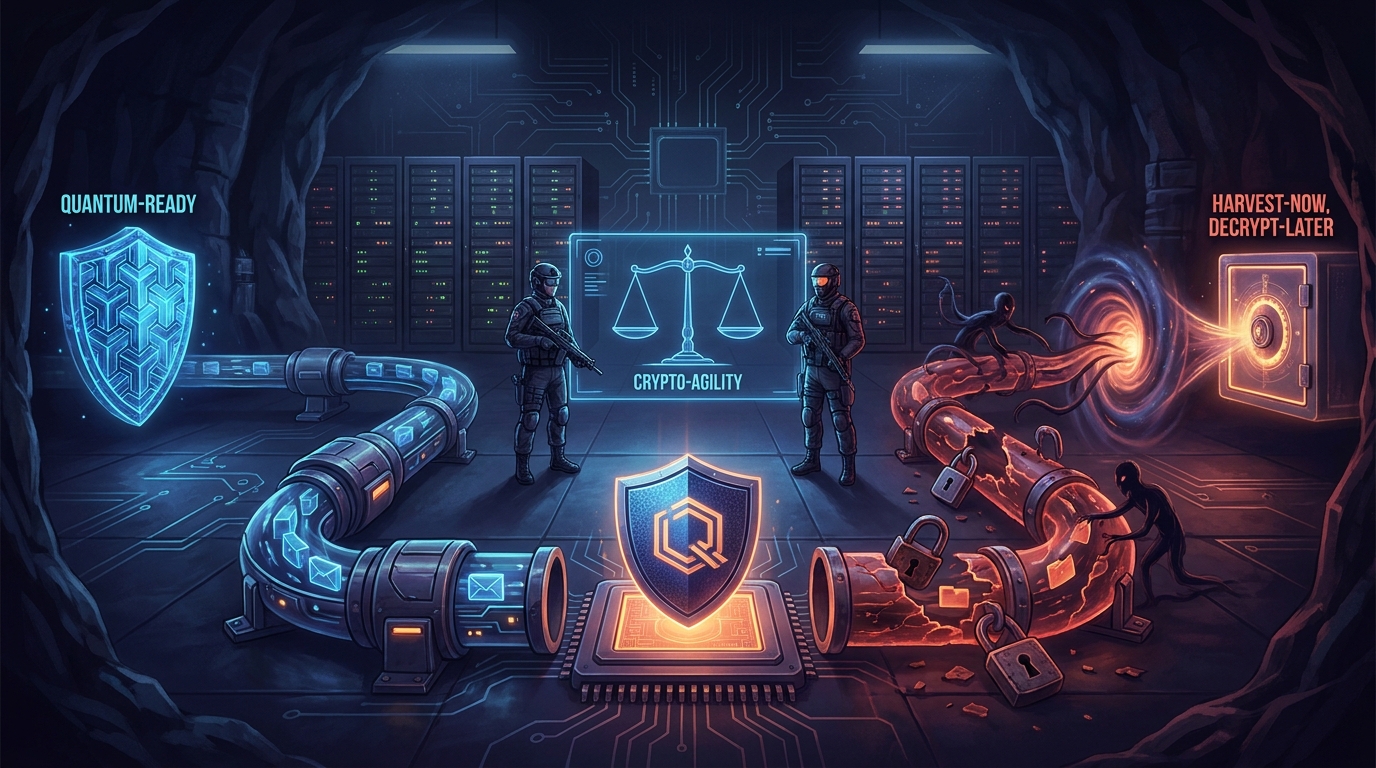
Quantum computing still has a long way to go before it can routinely break modern public-key cryptography at scale. That fact has become a dangerous comfort blanket for many security teams. The threat is not hypothetical, however: adversaries do not need a cryptographically relevant quantum computer today to profit from tomorrow’s decryption capability. They only need to collect encrypted traffic, archives, backups, and machine-to-machine data now, then decrypt it later when the math catches up.
This is the essence of harvest-now, decrypt-later (HNDL) attacks. For organizations with long-lived intellectual property, regulated records, industrial telemetry, medical data, OT commands, identity tokens, or software signing trust chains, the risk is immediate. The real question is no longer whether quantum-era cryptography will arrive. It is whether your data pipeline will still be readable when it does.
The answer depends on crypto-agility: the ability to swap cryptographic algorithms, protocols, keys, and trust anchors without redesigning the entire system. Organizations that can adapt quickly will be quantum-ready. Those that cannot will be quantum-exposed.
Why HNDL Is the Most Practical Quantum Threat Today
Public debate often focuses on “Q-day,” the moment a quantum computer becomes powerful enough to break RSA or ECC. But attackers do not need to wait for Q-day to create value. Sensitive data often remains useful for years or decades, and the encryption protecting it may be intercepted long before quantum decryption becomes possible.
That creates a simple but powerful attacker model:
- Intercept encrypted traffic at scale.
- Copy archives, backups, and cloud object storage snapshots.
- Capture VPN sessions, API traffic, software update chains, and identity assertions.
- Wait for mature quantum capability or exploit leaked keys, weak implementations, or migration mistakes.
- Decrypt or impersonate at a time of strategic advantage.
This is why several security and standards bodies are urging organizations to begin migration planning now rather than later. Even if quantum computers that threaten today’s public-key systems are not yet broadly available, the exposure window is already open for any data whose confidentiality horizon exceeds the lifespan of current algorithms.
What Quantum Breaks First, and What It Does Not
Not all cryptography is equally at risk. Understanding the difference matters, because quantum migration planning should prioritize asymmetric systems first.
Asymmetric cryptography: the urgent problem
Algorithms such as RSA, Diffie-Hellman, and elliptic curve cryptography underpin TLS handshakes, certificates, code signing, device identity, VPNs, SSO, and many PKI-backed workflows. Shor’s algorithm threatens these systems directly. If a sufficiently capable quantum computer exists, these trust mechanisms can be undermined in ways that affect confidentiality, integrity, and authentication.
Symmetric cryptography: still relevant, but needs strengthening
Symmetric algorithms are not “broken” in the same way. Grover’s algorithm offers a speedup, but not the same catastrophic collapse seen in public-key cryptography. The practical response is to use larger key sizes where appropriate, such as AES-256 rather than AES-128 for long-term protection.
Hashing and signatures: migration is nuanced
Hash functions remain usable, but their security margins and protocol roles should be reviewed. More importantly, any system relying on signatures for trust, provenance, or non-repudiation will need a post-quantum strategy. That includes signed firmware, signed container images, signed ML models, and signed software updates.
Why Data Pipelines Are Especially at Risk
Modern enterprises do not just store data. They continuously move, transform, enrich, and replicate it. This creates a large cryptographic attack surface across ingestion, transport, processing, storage, and distribution.
Quantum exposure becomes especially serious when pipelines rely on older assumptions about confidentiality duration or trust persistence. Common weak points include:
- API traffic between services protected by TLS with quantum-vulnerable key exchange.
- Data lake and warehouse replication across regions and providers.
- Backup and archival systems intended to remain confidential for years.
- Certificate-based service authentication between workloads, CI/CD, and platform tooling.
- Edge, OT, and IoT telemetry collected from devices that may operate for 10–20 years.
- Identity and access tokens used in federated systems and zero trust architectures.
If any of these systems use cryptography that cannot be upgraded without major disruption, the organization inherits a strategic weakness. The longer the retention period, the more attractive the target becomes.
Crypto-Agility: The Real Defense
Crypto-agility is not a product. It is an architectural capability. At its core, it means cryptographic components can be discovered, evaluated, replaced, and validated without breaking business operations.
A quantum-ready organization should be able to answer four questions quickly:
- Where is cryptography used?
- Which algorithms, libraries, protocols, and certificates are in use?
- Which assets must remain secure for 5, 10, 20, or more years?
- How rapidly can we replace a vulnerable primitive without redesigning the system?
Without those answers, migration becomes guesswork. With them, it becomes engineering.
The pillars of crypto-agility
- Cryptographic inventory: Map every place encryption, signing, key exchange, hashing, and identity validation occur.
- Algorithm abstraction: Avoid hard-coding a single cipher suite or signature scheme deep inside applications.
- Policy-driven selection: Use centralized policy to define approved algorithms, key sizes, and certificate profiles.
- Modular trust infrastructure: Design PKI and device identity systems so roots, intermediates, and trust anchors can be rotated.
- Testing and validation: Ensure new algorithms can be deployed safely across production-like environments before they are needed in crisis.

What a Practical Quantum-Readiness Program Looks Like
Many organizations overcomplicate quantum readiness by treating it as a future research project. It is not. It is an inventory, prioritization, and migration program with governance attached.
1. Build the cryptographic inventory
Start with visibility. Identify every system that uses public-key cryptography or long-term symmetric protection. Include cloud services, OT/ICS assets, developer tooling, software supply chain components, and third-party dependencies.
The inventory should record:
- Algorithm and key length
- Protocol and version
- Library or hardware module in use
- Data classification and retention period
- Business criticality
- Dependency on external certificate authorities or trust services
2. Rank data by confidentiality horizon
Not all data deserves the same migration priority. Classify by the period for which confidentiality must be preserved. Trade secrets, national security data, design files, patient records, and critical infrastructure telemetry often outlive ordinary encryption lifecycles by a wide margin.
Anything that must remain confidential beyond the likely arrival window of cryptographically relevant quantum computing should move to the front of the queue.
3. Identify the “hard to replace” systems
Legacy OT devices, embedded systems, medical equipment, and industrial controllers are often the most difficult to update. These systems may have limited compute, limited memory, vendor lock-in, or certification constraints that slow migration.
For these environments, compensating controls matter:
- Network segmentation
- Protocol gateways
- Encrypted tunnels with upgradeable endpoints
- Strict certificate rotation policies
- Asset retirement plans for unsupportable hardware
4. Plan for post-quantum cryptography
NIST has standardized the first wave of post-quantum cryptographic algorithms, and vendors are progressively integrating them into protocols and libraries. The near-term objective is not to rip out every existing control at once. It is to create hybrid and phased deployment paths that preserve compatibility while reducing quantum risk.
In practical terms, this means evaluating where post-quantum key establishment and signatures can be introduced first, especially in:
- TLS and mTLS connections
- VPNs and secure tunnels
- Code signing and software update pipelines
- Device identity and certificate lifecycle management
- Internal service-to-service authentication
5. Test downgrade resistance and failure modes
Crypto migration often fails not because the new algorithm is weak, but because the integration path is brittle. Attackers exploit downgrade possibilities, misconfigured negotiation, mixed trust stores, and partial deployment states.
Every migration plan should include testing for:
- Algorithm negotiation failures
- Fallback to legacy suites
- Certificate chain incompatibility
- Performance bottlenecks on low-power systems
- Operational rollback without reintroducing insecure defaults
Data Pipeline Breakpoints: Where to Start First
If resources are limited, organizations should focus on the parts of the pipeline that combine high sensitivity with long retention and high exposure.
High-priority zones
- Public-facing TLS termination: Especially endpoints handling PII, financial data, healthcare records, or proprietary data.
- Service mesh and east-west traffic: Internal compromise should not allow long-term interception of valuable data flows.
- Code signing and update infrastructure: A compromised trust chain can turn a software pipeline into a distribution mechanism for malicious code.
- Backup, archive, and object storage: These are classic HNDL targets because their data value persists for years.
- Identity systems: Federation, SSO, tokens, and certificate issuance are the backbone of trust.
Lower priority, but still relevant
- Short-lived operational telemetry with minimal sensitivity
- Ephemeral session data with rapid expiration
- Low-value internal logs, where legal and operational requirements permit shorter confidentiality horizons
Even here, organizations should avoid complacency. Adversaries frequently recombine low-value fragments into highly valuable intelligence.
The Vendor Problem: Waiting for “Quantum-Ready” Labels Is Not a Strategy
Many technology vendors now market products as quantum-ready. Some are serious. Others are simply rebranding existing capabilities or implying that special quantum hardware is required for security. That is a mistake.
Post-quantum security runs on existing hardware. In fact, the most urgent transition work is happening in ordinary enterprise infrastructure: browsers, servers, load balancers, HSMs, PKI stacks, appliances, and embedded controllers. Organizations should be skeptical of any roadmap that postpones action until a fully quantum-native replacement appears.
The better question is not whether a vendor uses the word “quantum.” It is whether the product supports crypto-agility, vendor-neutral migration, algorithm updates, and practical interoperability with current systems.
Governance: Quantum Risk Belongs in the Security Program, Not a Lab
Quantum readiness becomes real only when it is embedded in governance. That means executive sponsorship, risk ownership, budget, timelines, and reporting. It also means integrating quantum risk into existing enterprise resilience frameworks rather than treating it as a separate science project.
Recommended governance actions include:
- Assign a business owner for cryptographic inventory and migration.
- Track quantum exposure in risk registers and technology lifecycle plans.
- Require cryptographic review during architecture and procurement.
- Set migration milestones for high-value systems.
- Measure readiness with dashboards, not assumptions.
Security teams that cannot show which systems will be upgraded first are not ready. They are merely aware.
What Happens If Organizations Delay
Delaying migration creates several distinct problems. First, it compresses the timeline once quantum capability becomes more credible. Second, it increases the likelihood of emergency patching, interoperability failures, and rushed vendor dependency. Third, it leaves today’s encrypted material available for tomorrow’s adversaries.
For sectors such as finance, healthcare, telecom, government, defense, industrial manufacturing, and critical infrastructure, the impact is compounded by long retention periods and regulatory obligations. A breach years from now may trace back to a decision made today not to inventory cryptography or prioritize migration.
The most dangerous misconception is that “we will deal with it when quantum becomes real.” By then, the data may already be harvested and sitting in an adversary’s storage, waiting only for a sufficiently powerful machine to unlock it.
Sources / References
- [1] https://pqshield.com/the-quantum-threat-why-industrial-control-systems-must-be-ready/
- [2] https://www.paloaltonetworks.com/cyberpedia/quantum-readiness
- [3] https://cyberalberta.ca/system/files/CyberAlberta’s%20Quantum%20Readiness.pdf
- [4] https://www.deloitte.com/us/en/what-we-do/capabilities/quantum/services/quantum-cyber-readiness.html
- [5] https://blog.cloudflare.com/you-dont-need-quantum-hardware/
- [6] https://www.cyberthreatalliance.org/wp-content/uploads/2025/06/Approaching-Quantum-Dawn_JAR.pdf