
Artificial intelligence has fundamentally transformed the nature of cyber threats, enabling adversaries to launch attacks at unprecedented scale and sophistication while simultaneously reshaping how organizations defend their digital infrastructure. As AI-powered cyberattacks grow more lethal and autonomous, the distinction between traditional cybersecurity and modern cyber warfare has blurred into something far more dangerous: a domain where human defenders struggle to keep pace with machine-driven threats.
The Democratization of Cyber Warfare
Historically, sophisticated cyberattacks required specialized knowledge, significant resources, and years of technical expertise. Nation-states and elite hacking groups maintained monopolies on advanced offensive capabilities. That era has ended.
AI has democratized cybercrime. The barrier to entry for launching devastating attacks is lower than ever before. Today, threat actors with minimal technical skill can leverage AI tools to generate convincing phishing emails, craft sophisticated social engineering campaigns, and even develop malware code at scale. A would-be attacker no longer needs fluent English or years of programming experience; AI handles the heavy lifting. This democratization means that nation-states, criminal organizations, hacktivist collectives, and lone actors now operate on more equal footing than at any point in cyber history.
The implications are staggering. Where cyberattacks once required meticulous planning and execution, AI enables threat actors to generate malware code en masse and automate attacks across thousands of targets simultaneously. The speed advantage is overwhelming—what took weeks of manual effort now takes hours or minutes.
AI-Powered Attack Vectors: The New Arsenal
AI has expanded the attacker’s toolkit in ways that traditional cybersecurity defenses were never designed to counter. Understanding these vectors is essential for any organization serious about cyber resilience.
Phishing and Social Engineering at Scale
AI-generated phishing campaigns represent one of the most immediate threats facing organizations today. Generative AI can produce convincing, grammatically flawless emails tailored to specific targets, complete with culturally appropriate references and company-specific details harvested from public sources. These campaigns bypass human skepticism by appearing authentic in ways that traditional phishing attempts never could.
Beyond email, AI enables sophisticated vishing (voice phishing) attacks using deepfake voice synthesis and social engineering simulations that identify organizational vulnerabilities before human attackers exploit them. The speed and personalization of these campaigns make them exponentially more effective than their predecessors.
Advanced Malware and Zero-Day Exploitation
Traditional malware detection relies on signature-based identification—flagging code that matches known patterns. AI-powered malware generation creates variants that evade these signatures while maintaining functional equivalence. Threat actors can generate thousands of malware variants, each slightly different, overwhelming signature-based detection systems.
More critically, AI accelerates the discovery and exploitation of zero-day vulnerabilities. Machine learning models can analyze codebases, identify potential weaknesses, and even generate exploit code—compressing the timeline from vulnerability discovery to weaponization from months to days or hours.
Deepfakes and Synthetic Content Warfare
AI-generated deepfakes represent a qualitatively different threat category. Deepfake videos of executives authorizing fraudulent wire transfers, deepfake audio of CEOs approving unauthorized transactions, and synthetic content designed to manipulate markets or public opinion introduce an entirely new attack surface. The cognitive barrier to social engineering—the need to sound or appear credible—has been eliminated.
The Defense Paradox: Why Traditional Security Fails
Organizations have built their cybersecurity architectures around human-speed threat detection and response. Firewalls filter traffic. Intrusion detection systems scan for known attack signatures. Security analysts investigate alerts. This model assumes defenders have time to react.
AI-powered attacks shatter this assumption. The speed of machine-driven threats vastly exceeds human response capabilities. A sophisticated attack can compromise critical systems, exfiltrate data, and establish persistence before human analysts even receive the first alert. Traditional security hygiene—patching systems, updating signatures, conducting penetration tests—occurs at a pace incompatible with the velocity of AI-powered threats.
The false-positive problem compounds this challenge. As attack sophistication increases, so does the noise in security monitoring systems. Human analysts become overwhelmed, reducing their ability to identify genuine threats amid thousands of false alarms. The defender’s workload grows exponentially while their effectiveness paradoxically declines.
AI as Defense: The Necessary Counter
If AI enables unprecedented attack capabilities, only AI-powered defense systems can effectively counter them. Modern cybersecurity has entered an era where machine-versus-machine conflict occurs at machine speed, with human analysts providing strategic oversight rather than tactical response.
Threat Detection and Behavioral Analytics
AI excels at pattern recognition and anomaly detection in ways human analysts cannot match. Rather than relying on preset rules or known signatures, AI-powered systems build behavioral profiles of normal activity—which files users typically access, where they connect from, what systems they interact with—and flag deviations from these baselines as suspicious.
This approach is particularly powerful because it detects novel threats that don’t match historical patterns. If a system suddenly receives massive traffic from an unfamiliar foreign server, or a user accesses sensitive files at 3 a.m. from a different country, AI flags it for review. The system learns continuously, improving its detection accuracy over time and adapting to emerging threat tradecraft.
Autonomous Response Systems
The most advanced AI-powered defenses operate autonomously, making real-time decisions without human intervention. Rather than alerting analysts to potential threats, these systems automatically isolate compromised systems, revoke suspicious credentials, block malicious traffic, and initiate incident response procedures. AI-mediated threat response can lead to swift and effective action, significantly reducing the window of opportunity for attackers.
This automation is essential because human-mediated response is inherently slow, error-prone, and unreliable when facing threats operating at machine speed. The ability of AI to learn from past incidents improves response accuracy over time, making these systems adaptable to evolving attacker tactics.
Predictive Threat Intelligence
AI models trained on historical threat data and current indicators can predict likely attack vectors before they materialize. By analyzing the behavioral patterns of known threat actors, the evolution of malware and ransomware strains, and emerging tactics and techniques, AI can identify which threats an organization is most likely to face and recommend preemptive defensive measures.
This shift from reactive to predictive defense represents a fundamental change in security posture. Rather than responding to attacks after they occur, organizations can harden their defenses against anticipated threats.
The Concentration Risk Problem
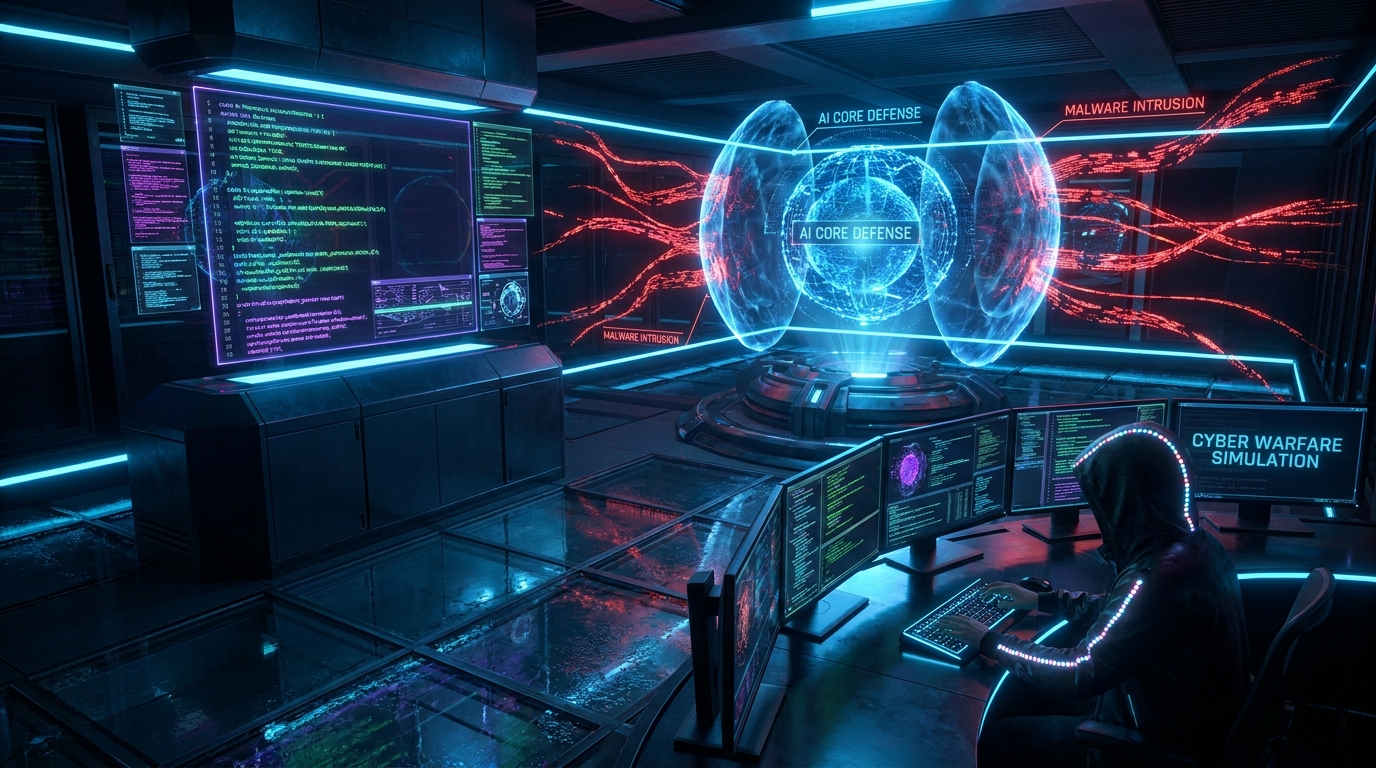
As AI capabilities concentrate in the hands of both attackers and defenders, a critical vulnerability emerges: infrastructure concentration. The world’s digital infrastructure is absurdly centralized. AWS, Microsoft Azure, and Google Cloud control approximately 65% of the global cloud market. A successful AI-powered attack against any hyperscaler doesn’t merely affect individual customers; it disrupts the operational capacity of entire nations, militaries, and critical infrastructure networks.
This concentration creates what might be termed „systemic cyber risk“—the possibility that a single successful attack could cascade across vast portions of the global internet. The recent physical strikes against AWS facilities in the Middle East demonstrated that this risk extends beyond purely cyber threats to encompass kinetic attacks on data centers themselves.
The Convergence of Cyber and Kinetic Warfare
The distinction between cyber warfare and traditional military operations has collapsed. Nation-states now view cloud infrastructure and data centers as legitimate military targets. This convergence creates a new strategic calculus: why spend months developing a sophisticated cyberattack when conventional weapons can permanently destroy the infrastructure supporting your adversary’s digital operations?
For security professionals, this represents a fundamental shift in threat modeling. Physical security, geopolitical risk assessment, and military doctrine must now be integrated into cybersecurity planning. A data center’s resilience depends not only on redundancy and failover capabilities but on its ability to withstand kinetic attack.
Emerging Trends: The Next Frontier
The AI cybersecurity landscape continues to evolve rapidly. Several emerging trends will shape the future of cyber warfare:
- Generative AI Market Growth: The generative AI segment of the cybersecurity market is expected to grow almost tenfold between 2024 and 2034, indicating massive investment in both offensive and defensive AI capabilities.
- Autonomous Defense Systems: Future defenses will operate with minimal human intervention, making split-second decisions to contain threats before they spread.
- Privacy-Preserving AI: As AI becomes central to security operations, protecting the privacy of the data used to train these systems becomes critical, leading to development of privacy-preserving machine learning techniques.
- Quantum-Resistant Security: Organizations are preparing for the post-quantum era, where current encryption methods become obsolete. AI will play a central role in identifying and implementing quantum-resistant alternatives before adversaries develop quantum computers capable of breaking current cryptography.
The Three Pillars of AI-Powered Defense
Effective defense against AI-powered cyber warfare requires a coordinated approach across three critical domains:
- Automated Security Hygiene: Self-healing software code, self-patching systems, continuous attack surface management, and zero-trust architecture reduce manual workloads while strengthening protection against attacks targeting core vulnerabilities. Automation ensures that routine defensive tasks occur at machine speed rather than human pace.
- Autonomous Defensive Systems: Machine learning and real-time analytics enable systems to learn from threats, identify attack patterns, and counteract them proactively. Moving-target defense and deceptive tactics allow organizations to shift from reactive to proactive postures.
- Augmented Executive Oversight: While AI handles tactical response, human leaders must maintain strategic oversight, making critical decisions about risk tolerance, resource allocation, and organizational priorities. The human role shifts from tactical execution to strategic governance.
Actionable Imperatives for Security Leaders
Organizations facing this new threat landscape must act decisively:
- Invest in AI-powered detection and response: Legacy security tools are inadequate. Organizations must deploy modern, AI-enhanced security platforms capable of detecting and responding to threats at machine speed.
- Implement zero-trust architecture: Assume compromise. Verify every access request, monitor all user behavior, and segment networks to contain potential breaches.
- Integrate physical and cyber security: Data center security, cloud infrastructure resilience, and geopolitical risk assessment must be unified under a single strategic framework.
- Prepare for quantum threats: Begin transitioning to post-quantum cryptography now. The window to migrate before quantum computers become operational is narrowing.
- Develop threat intelligence capabilities: Organizations must maintain awareness of emerging AI-powered attack techniques and adapt defenses accordingly. Threat intelligence is no longer optional—it’s foundational.
Conclusion: The New Normal
The role of AI in modern cyber warfare represents a fundamental inflection point in security history. Attacks now occur at machine speed, scale at unprecedented levels, and leverage capabilities that were previously the exclusive domain of nation-states. The democratization of AI-powered offensive tools means that sophisticated attacks are no longer rare events conducted by elite adversaries; they are becoming routine.
Simultaneously, AI-powered defense systems are evolving to meet these threats, creating a new equilibrium where machines defend against machines at speeds humans cannot match. The security professionals who thrive in this environment will be those who understand that cyber warfare is no longer purely a technical domain—it encompasses geopolitics, military strategy, infrastructure resilience, and organizational risk management.
The age of cyber-only thinking has ended. The age of integrated, AI-powered cyber-physical warfare has begun. Organizations that fail to recognize this transition will find themselves vulnerable to threats they cannot detect, let alone defend against. The time to act is now.