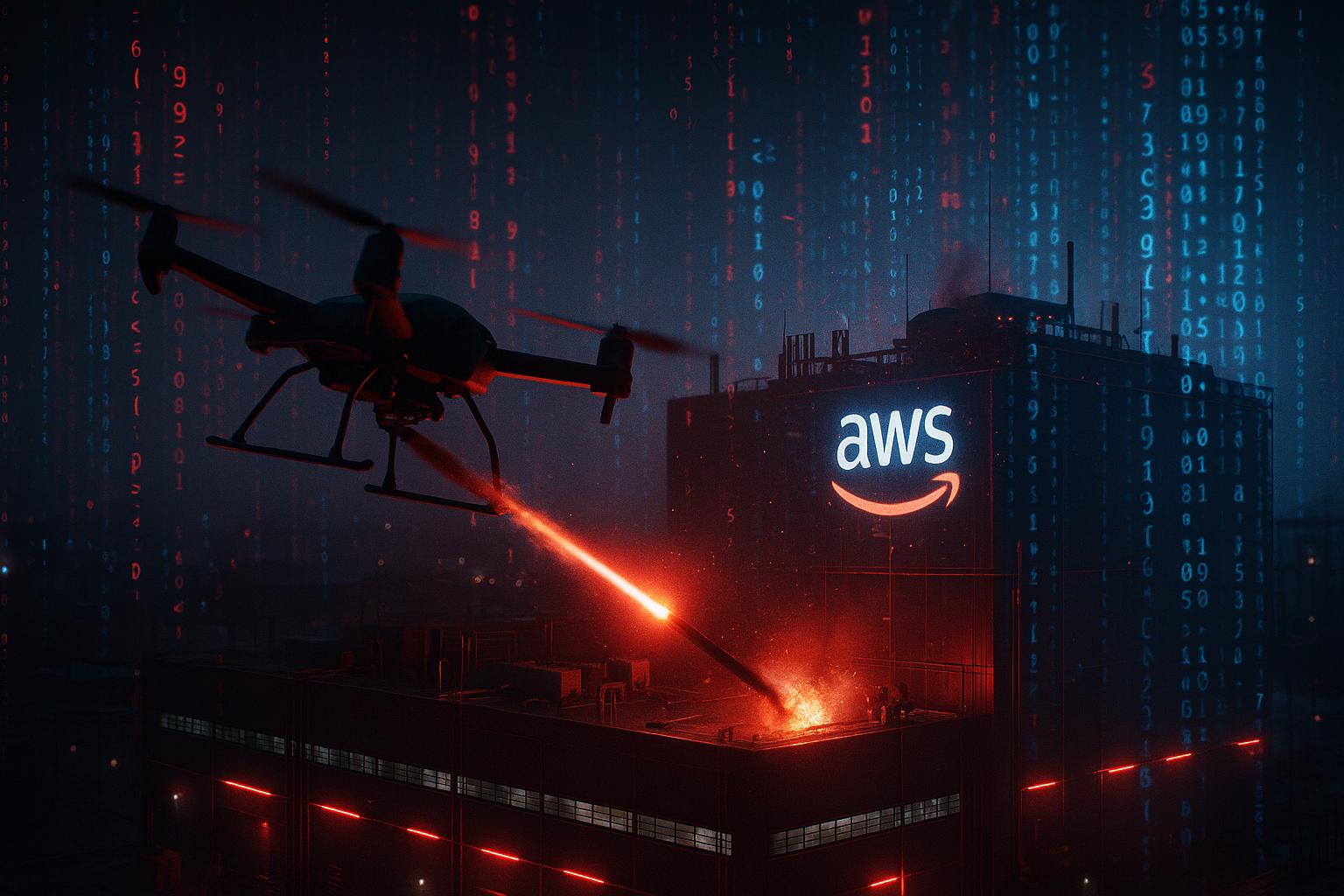
On March 3, 2026, the line between cyberwarfare and kinetic warfare blurred forever. Iranian drones targeted Amazon Web Services data centers across the Middle East—marking the first time a nation-state launched direct military strikes against a U.S. hyperscaler’s physical infrastructure.
This wasn’t a DDoS attack. This wasn’t a breach. This was a drone strike.
The Attack Nobody Saw Coming
In the aftermath of US-Israeli military operations against Iran, Tehran’s Islamic Revolutionary Guard Corps (IRGC) retaliated not with cyber operations, but with physical force. Two AWS regions in the United Arab Emirates and one facility in Bahrain came under attack via unmanned aerial vehicles carrying conventional weapons.
Amazon’s official statement was stark: „The strikes caused structural damage, disrupted power delivery to our infrastructure, and in some cases required fire suppression activities that have resulted in additional water damage.“
What started as a technical incident rapidly escalated into a geopolitical crisis. AWS, the world’s largest cloud infrastructure provider, had become a legitimate military target.
Why AWS? Why Now?
To understand the Iranian calculus, one must recognize that AWS infrastructure isn’t just commercial—it’s essential to U.S. military, intelligence, and critical infrastructure operations. The CIA, NSA, and Department of Defense all rely on AWS services. Major U.S. corporations, government agencies, and NATO allies depend on the cloud services hosted in these regions.
The UAE and Bahrain facilities serve not only commercial clients but also U.S. diplomatic operations, military logistics, and allied intelligence networks. For Iran, these data centers represented tangible targets that could inflict economic and operational damage on the United States without crossing into nuclear weapons territory.
It was asymmetric warfare reimagined for the cloud era.
The Technical Fallout
AWS operates through a distributed architecture designed for redundancy—multiple availability zones within each region, separated by meaningful distances (60-100 kilometers apart) but connected by ultra-low-latency networks. The theory was sound: one zone down, services fail over to another.
But the March 2026 strikes hit multiple zones across multiple regions simultaneously. The coordinated nature of the attack suggested either advanced intelligence on AWS infrastructure layouts—or deliberate targeting of the known geographic boundaries.
Services across the Middle East, South Asia, and parts of Europe experienced cascading failures. Banking systems in the region struggled with transaction processing. Diplomatic communications encrypted through AWS-hosted systems faced brief but critical outages. Emergency response coordination in allied nations suffered disruption.
For 6-8 hours, portions of the global internet’s backbone experienced degradation.
The Precedent That Changes Everything
This was unprecedented. Not because attacks on infrastructure are new—they’re not. Not because nations have contemplated striking datacenters—they have. But because someone actually did it.
The geopolitical implications are staggering:
Cloud Infrastructure as Military Target: AWS, Microsoft Azure, Google Cloud, and Alibaba Cloud now occupy the same strategic space as power plants, telecommunications networks, and military installations. If one nation can strike cloud infrastructure, others will calculate the same logic.
Concentration Risk Becomes National Security Risk: The world’s digital infrastructure is absurdly concentrated. Three companies—AWS, Azure, Google—control roughly 65% of global cloud market share. An attack on any single hyperscaler doesn’t just affect customers; it affects the operational capacity of entire nations.
The Cyber-Physical Convergence: For decades, cybersecurity and physical security operated in separate domains. But the Iran strikes demonstrate that these worlds have merged. A drone carrying conventional explosives can achieve what the most sophisticated cyberattack cannot: permanent infrastructure destruction.
International Law in Uncharted Territory: Did Iran violate international law? The question is maddeningly complex. International humanitarian law hasn’t adequately addressed cloud infrastructure. Is an AWS data center „critical infrastructure“? Is targeting it a war crime? Expect years of legal and diplomatic wrangling.
Industry Response: Scrambling for Solutions
In the aftermath, hyperscalers are reconsidering their footprints. AWS announced expansion of geographic redundancy. Microsoft and Google followed suit. None of them, however, can guarantee protection against state-level kinetic threats without investing in air defense systems—something outside their domain.
What Comes Next?
The Iran strikes revealed a fundamental vulnerability in how the world’s digital infrastructure is organized. Three scenarios loom: escalation by other nation-states, hardening of infrastructure with militarized protection, or restructuring along geopolitical lines creating regional networks.
The New Normal
For security professionals, the message is clear: cloud infrastructure is no longer purely a cybersecurity concern. Physical security, geopolitical risk, military doctrine, and infrastructure resilience must now be considered together.
The age of cyber-only thinking has ended. The age of cyber-physical warfare has begun.
And AWS, for all its engineering sophistication and redundancy planning, discovered that some threats originate not from code, but from the sky.